Pulko Patent Baukasten - Pulkowski
 edge
edgePulko is a wooden building construction set, with a ground plates, columns, infill plates & floors.
Pulko was patented in 1919 by Erich Pulkowski from Dessau and manufactured in Lechenich (near Köln) by Holzbearbeitungswerk Lechenich, by Michael Engels. It was marketed by Carl Josef Bollig & Co., toy exporters from Mönchengladbach. The game exists in 4 languages: German, Englisch, France & Dutch.
It's briefly produced till 1920~1922 and most likely sold up to ~1928. The system then seem to continue (somehow) into Mobaco.
More detailed information: mobaco.nl/Pulko
Timeline
An comprehensive timeline, for better understanding the Pulko developments and other potential derivatives:
Prior-Art (toy technology, similar to Pulko, already publicly available):
- ~1887: "....", Adolph Engel, Berlin (GE)
- Using base plates; round columns, with grooves; colorful cardboard panels.
- ~1889: "SKY-HI / SKI-HI", patented, by McLoughlin (USA)
- Using base plates; round columns, with grooves; colorful cardboard panels.
- Early 1900s: "Der Pferde-Stall", Julius Stief (GE): (more info will follow..)
- Using base plates; square columns, with grooves.
- Wooden panels, (w. colorful paperwork attached).
- 1901~1910: Stella Baukasten ("Stella," "Stern", Estrella") (GE, SP, UK, ..), by Hermann Fiedeler:
- Using square columns, with grooves.
- 1917~1954: L'Edifice (FR):
- 1917 Oct.: Issued the first patent:
- Square columns, with grooves.
- 'Strange' floor strip designs (Fig. 8), very similar to later Pulko prototypes & patent.
- 1919 May: Registered design: Only wooden parts, difficult to produce in large series.
- 1917 Oct.: Issued the first patent:
Prototyping series: "Pulko-Baukasten", by E. Pulkowski (square columns; wooden panels):
- The "Pulko-Baukasten" system: The invention was basically square columns into square base plate holes.
(Re-using: Floor strips from L'Edifice? Knowing the available (German) toy sets at the time?) - Created comprehensive prototypes (see: photo 1922 Liepzig trade fair).
- Created instruction manuals, based on these photos (see: photo 1922 & Caro-sale).
- 1919 March: Erich Pulkowski issued a granted patent about this construction game (valid for Germany only).
Production series: "Pulko-Patent-Baukasten" with M. Engels (round columns):
- 1920 Feb: "Pulko-Patent-Baukastenwerke Lechenich Pulkowski u. Engels” was registered.
- 1920 April: Michael Engels started a company: "Holzbearbeitungswerk Lechenich" and produced Pulko, sets: Addo to Baldo (and prototypes for Caro?).
- 1920 Nov.: Dutch advertisement, referring to Set-3 Caro.
- 1921 Aug. 18-Sept 3th: Liepzig trade fair.
1921 Sept. 6 to 16th: Carl Joseph Bollig had a stand at the Jaarbeurs trade fair in Utrecht, the Netherlands, also showing 'Pulko Patent Baukasten'. - 1922 May: Michael Engels terminated his company.
(Assumption: Although the many part iterations during this period, the wooden system (Addo/Baldo) did not seem to be profitable.) - 1922 (Sept.?): Liepzig trade fair: Showing a stand with the potential of the "Pulko Patent Baukasten" system.
- 1922 Nov.: Dutch advertisement, referring to Set-3 Caro.
Production series: "Mobaco", by Moubal (square columns, cardboard panels):
(This product is definitely based on Pulko Baukasten. But it's still unknown if there was any form of agreement with E. Pulkowski.)
- 1924: Moubal started Mobaco sales, (NL, UK, FR, but not GE).
- 1928: 'Pulko' listed on sale ad in Batavia (Jakarta), Indonesia.
(Assumption [AG]: Price is very low → dumping large batch of "1st production" series?) - 1931 Sept.: The company "Pulko-Patent-Baukastenwerk Erich Pulkowski" was terminated.
- 1931-1935: Many new 'Mobaco' inventions and new boxes. (License agreement terminated after 10y??)
- 1962: Mobaco was discontinued.
Other potential licenses or just copycats(?)...
- 1930s: "El Constructor Infantile (licensed!)". (Copy of Mobaco production, sold in Argentina.)
- 1930..(60)?: "Wilfried - Der kleine Baumeister". (Copy of Mobaco production, sold in Germany.)
- 1940s: "Fabro". (Copy of Mobaco production, sold in England.)
Newer releases (after introduction of Lego):
- 1960/70s: "Donald Architect / Donald Arquitecto", produced in Spain.
(First series, also cardboard. Under license from the Walt Disney Corporation.) - (Many more attempts selling boxes like 'Pulko Baukasten', incl. laser cutted plastic panels..)
- 2000s: "MiniPlex", (CNC milled wooden panels) inspired by Mobaco, produced in NL.
- 2016 till today: "Casitas FRM", (stamped cardboard panels) inspired by El Constructor Infantil, still produced in Argentina & sold.
- 2019 till today: "Tatami", (laser cut panels) inspired by memories from Mobaco box, still produced in Argentina & sold world wide.
Reading the long history of 'Pulko Baukasten' developments & derivatives, Erich Pulkowski dream is still alive today.
The rest of this page is about "Pulko Baukasten" part development, up to ~1922 and the associated 3D library.
Patented
DE319745, by Erich Pulkowski, prior art: March 1919.
Here a 3D presentation is made of the parts from the patent:
1922 - Liepzig trade fair (square columns)
Let's jump directly to 1922 and have a look to this great photograph from the stand:
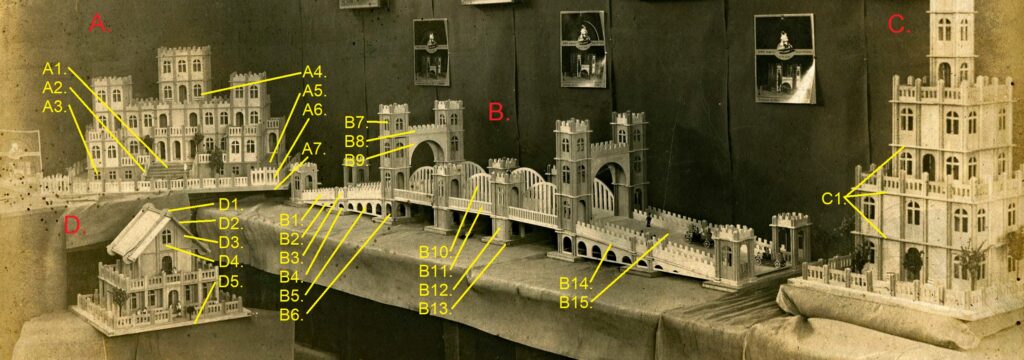
What do we see:
- 4 different buildings,
- many, many different parts, which are not used in to known "Sets 1 to 2".
My association with this photograph:
Erich Pulkowisky, wanted to show (& sell) the potential of the "Pulko-Patent-Baukasten" system.
In detail:
- Buildings A & B (~1919/'20): Prototypes: showing potential creating many different building types.
(These buildings still using floor strips from the patent.)
(Not completely sure: Are there 2 tints of 'colors' visible? Could the darker version being green?)
(Building B: A replica of "The Bridge" still exists today. It's located somewhere in The Netherlands.) - Building C (~1919/'20): Prototype parts used, showing content of known boxes: Addo, Adbal & Baldo.
(Boxes & manuals are also displayed on the walls, even showing 'Set-3 Caro bridge' on the front cover.)
(This building also demonstrates the stability of the system, building sky-high.) - Building D (?): 'Swiss chalet': (assumption) latest prototype, for buildings with angled roofs.
(Showing "Gable type I" & "Roof type I".)
Origin of buildings...
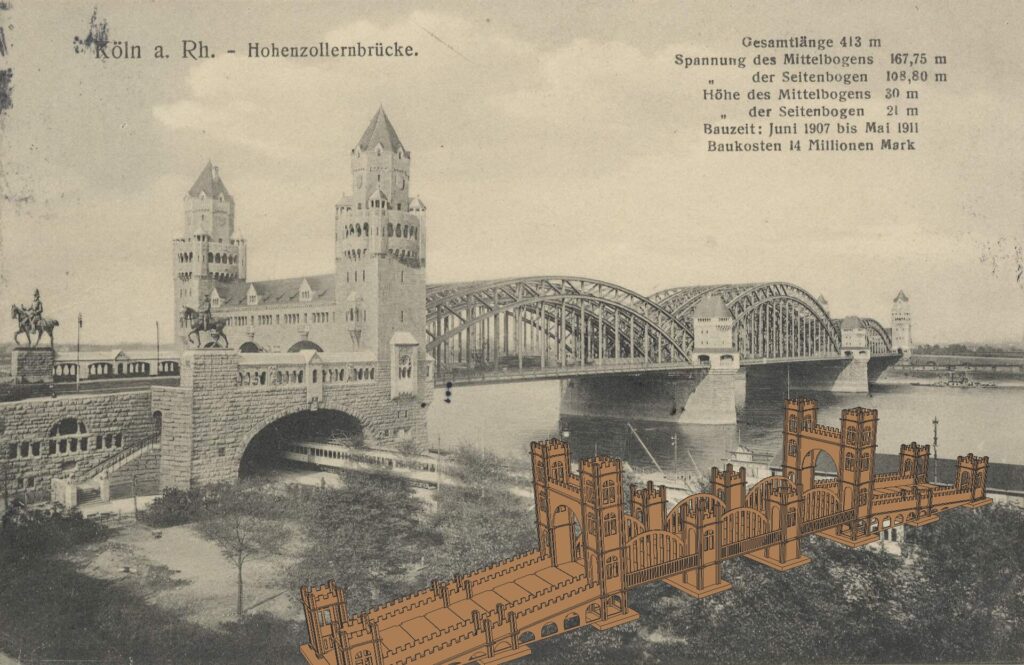
During these years, Erich Pulkowski lived in/around Köln, Germany. It's very likely, the bridge (B) is based on 'Die Hohenzollernbrücke':
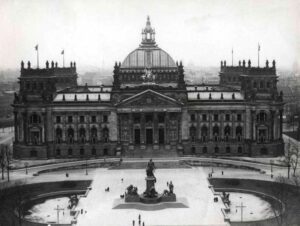
Perhaps a bit far-fetched, prototype A building might represent the 'Reichstag - Berlin'?
(If someone knows a better match, let us know.)
1920-'22: Box covers, buildings & manuals (round columns)
During these years, the system is still under development. Examples of boxes Addo & Baldo:


There are different boxes for sale:
- Box 1: Addo
- Box 1a: AdBal
- Box 2: Baldo
- Box 2a: Balcar (box cover not yet found)
- Box 3: Caro (box cover not yet found)
Some highlights:
- So far only Addo, Adbal and Baldo boxes have been found.
- The building -on the front cover of boxes Addo to Baldo-, could be build with Set-3: Caro, having 3 story columns.
Example boxes front cover building:
Manuals
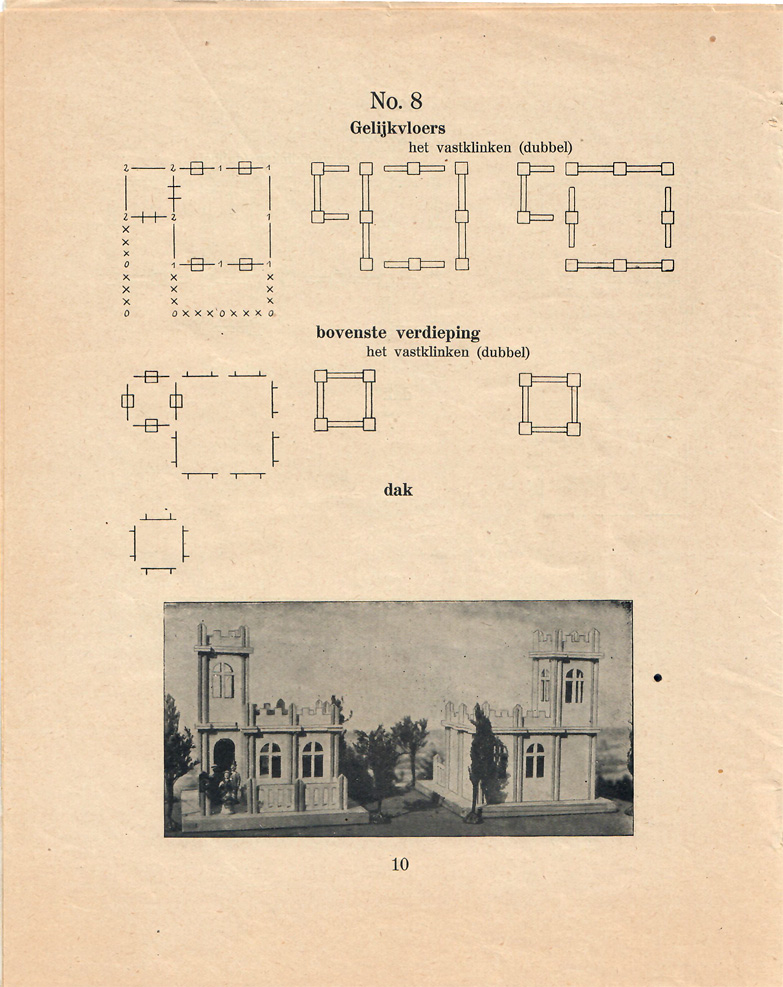
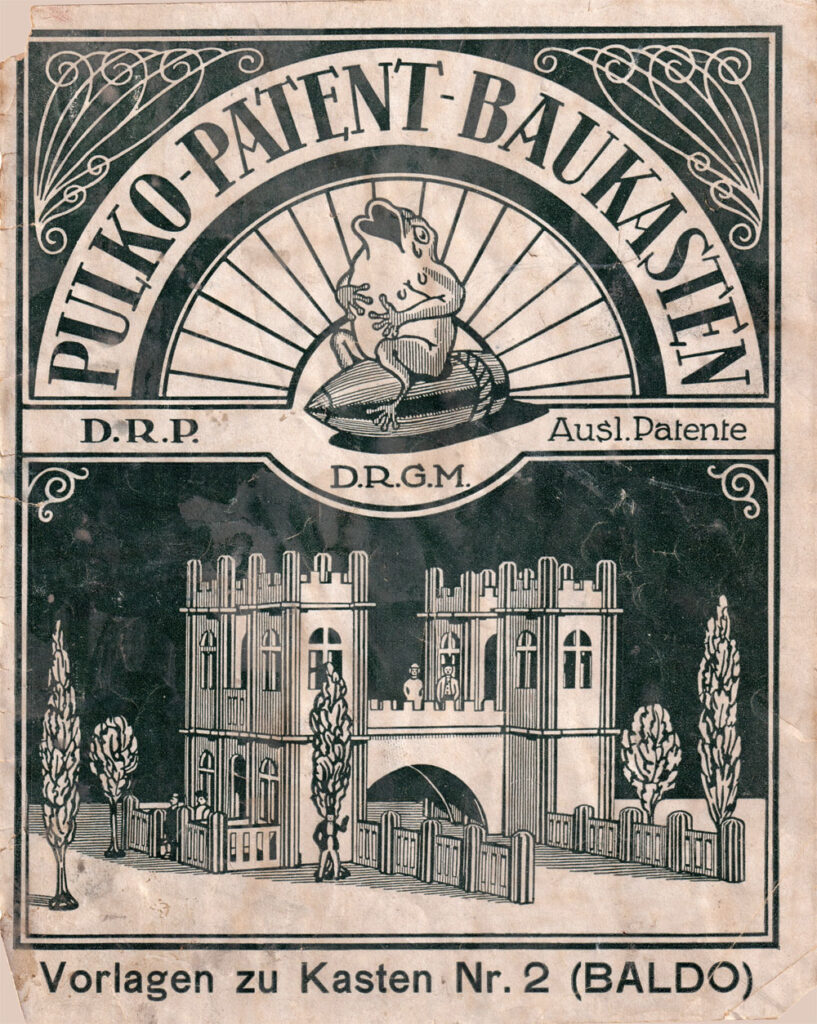
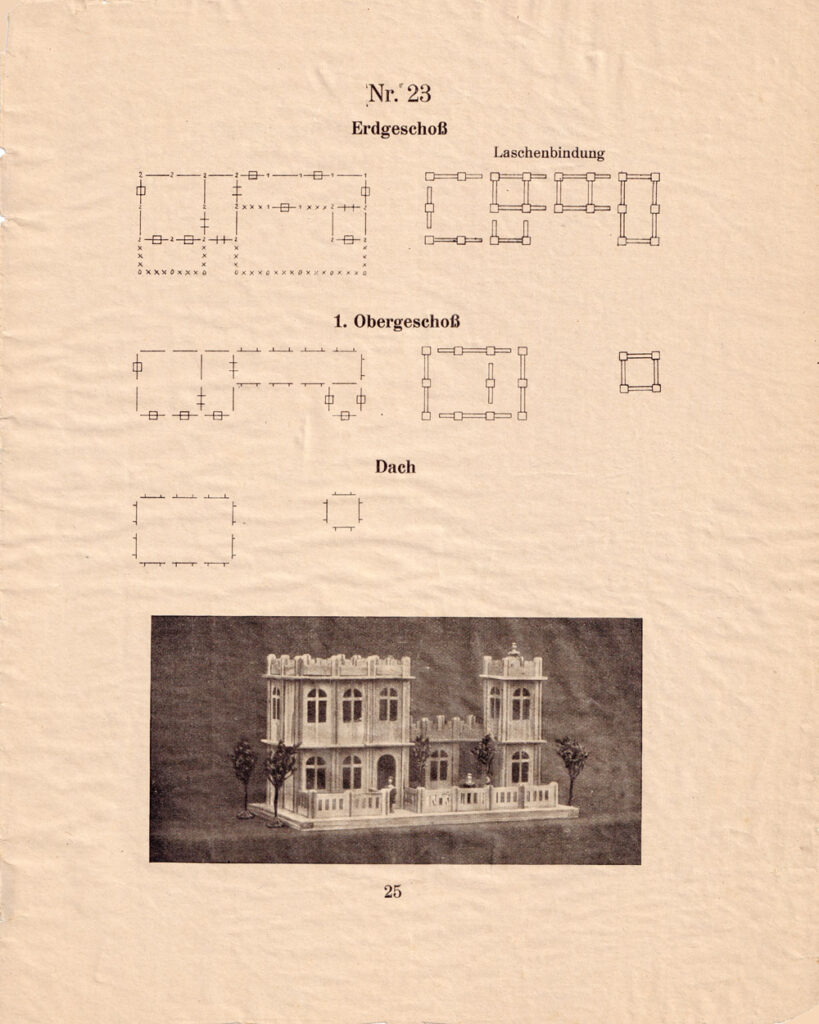
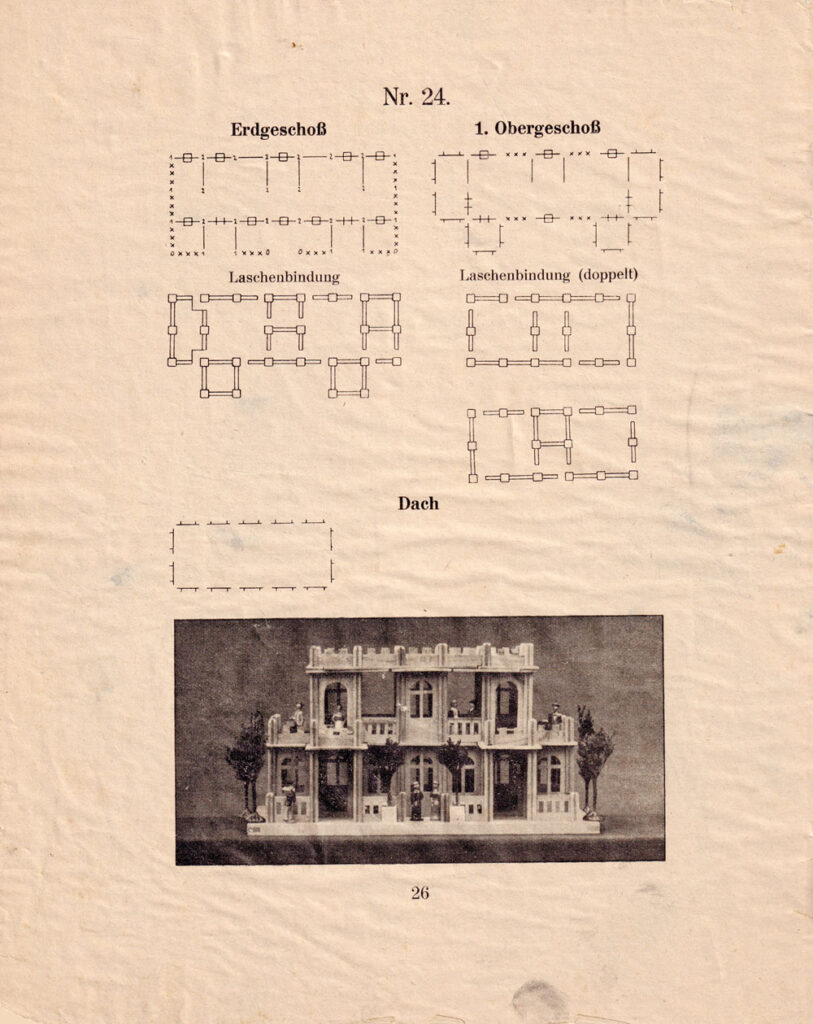
Here pictures from both front cover & 'building examples' from the manuals, found in the boxes: Set-1 & Set-2:
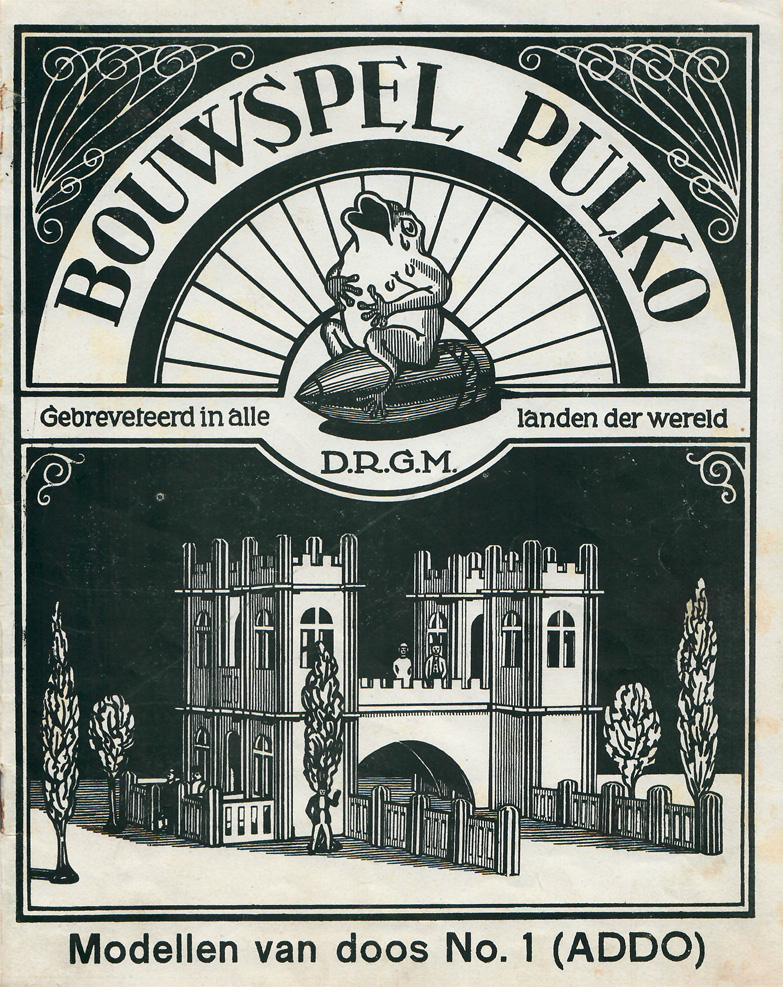
Some interesting highlights:
- Beside the difference in language, there are (at least) 4 versions of manual front covers, with titles:
- "Pulko": (see below, still prototype phase: '19/'20s?)
- "Bouwspel Pulko" (NL) (around '20s?)
- "Pulko-Patent-Baukasten" (GE) (+'20s?)
- Colored (Addo) "Pulko-Patent-Baukasten".
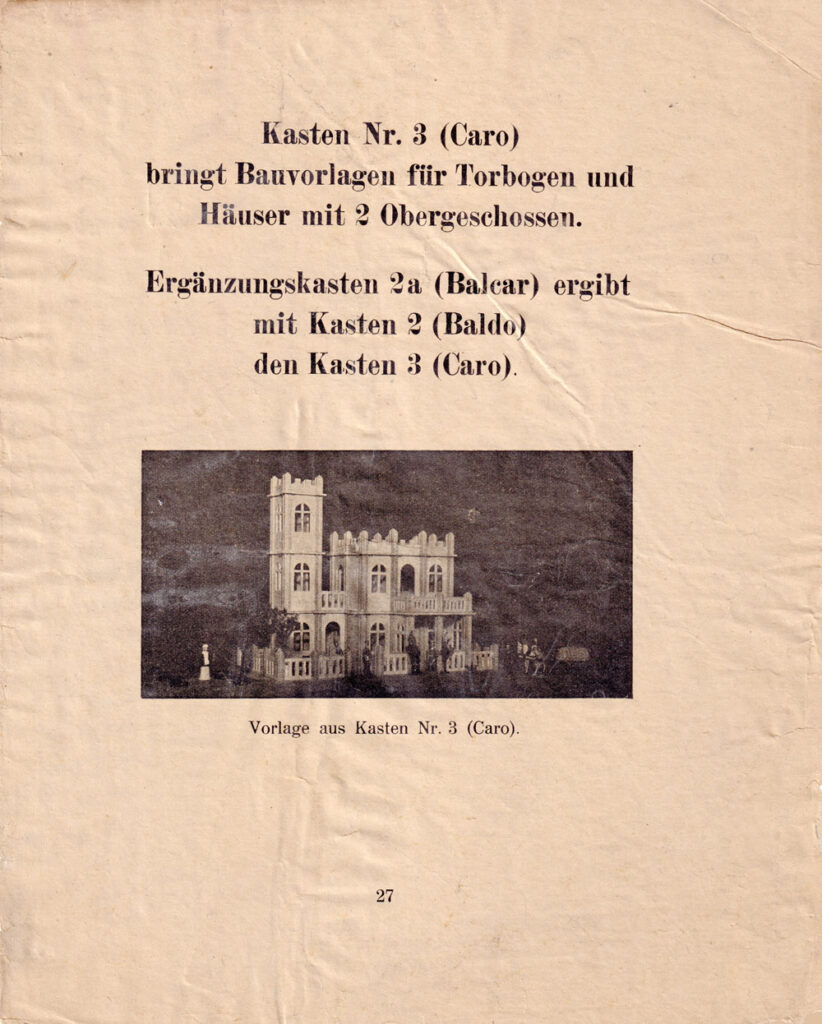
- The last page of manual Set-2, is referring & showcasing an example for Set-3, stating:
"The bridge parts ("Torbogen") on the manual cover and 3 stories buildings could be build with box nr. 3 Caro."- So with Set-2, you are not allowed to create 3 story buildings... 😉
Likely explanation: Set-3 has now also 3 story length columns. - With Set-3, it's possible to build bridges, which might very well shown on the front cover of all manuals up to Set-2.
- So with Set-2, you are not allowed to create 3 story buildings... 😉
- The front cover for the manuals up to box nr 2, are showing bridge parts and 3-span-width-crenelated wall panels on top.
(These parts could also be traced back to the prototype building: "The Bridge", parts B8 & B9.)
Assumption: There were plans for selling Set-3 Caro, including parts B8 & B9, but was not (yet) the focus.
Example Set-2, Baldo No. 23:
Example Set-3, Caro: Bridge / Rail way model.
Set-3 Caro items...
Recently 'green' parts and a manual "Nr. 3 (Caro)" have been found, together with some known "Pulko-Patent-Baukasten" sets. Unfortunately, it's unknown if there was also a "box Caro" present. (Would be great to get incontact with the new owner...)
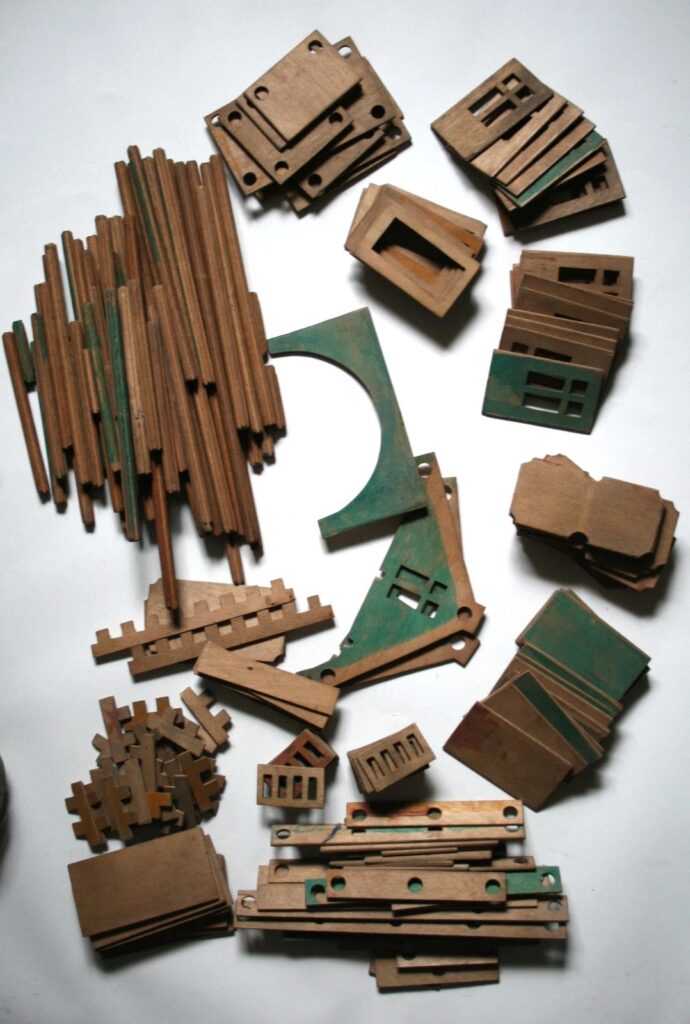
Photo courtesy: ebay, via [BW]
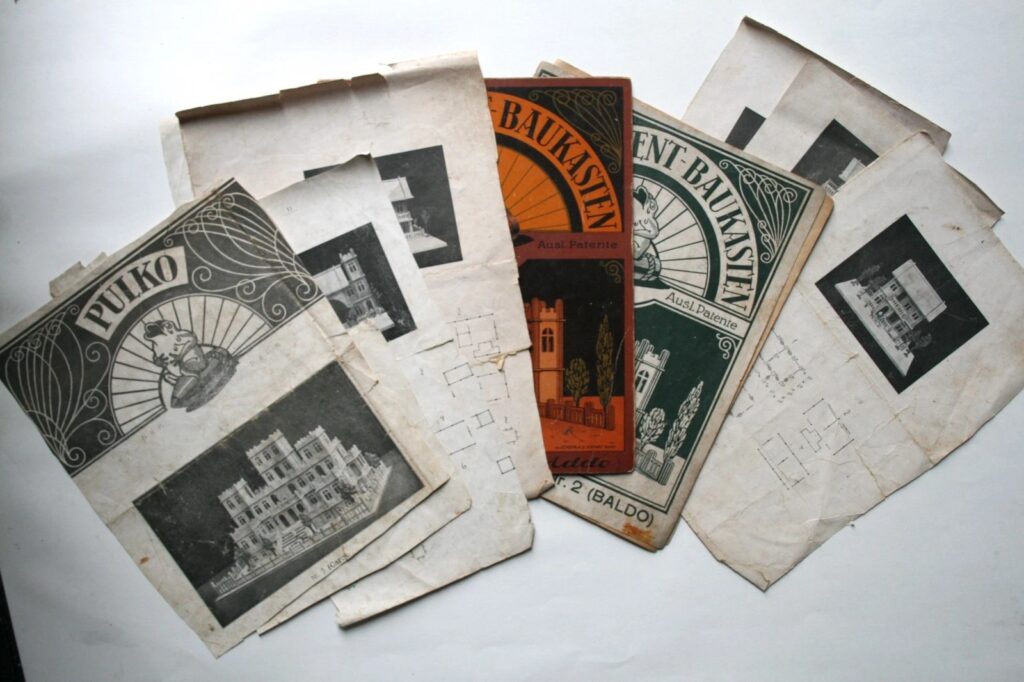
Details parts: Caro items
- Green panels!
(Likely one side painted and the other side natural?
The B/W prototypes A & B, also showing different tints, could these be painted too?) - Columns: Both round columns types are used: compatible with the existing Sets 1-2.
(Note: this lot is contaminated by different Pulko boxes...) - Bridge parts: B8, B9.
- Beside the color, floor strips & panels are similar like Sets 1-2.
- Window panels: 4 square holes.
(Also seen on the smaller windows, from prototype building A3.)
(Similar transition within Mobaco, around 1930.) - New door panels: rectangular doorway.
(Similar suggestions for Mobaco 'ArtDeco' doors ~1933.) - New gable panels, type-III:
- This is a one-panel design, which differs from type-I from the prototype building D.
- This gable allows round columns to be sticked through.
- This gable having 4 square window holes.
- This gable design differs from the version inside these instructions, it's having a 'chimney?' on top.
- New roof system, type-II:
- This 'gable-III' allows for sticking through round columns, which will hold the rectangular roof plates
- Roof plates (right bottom corner):
- Bit longer then standard wall panels (so these are not interchangeable).
- Types: standard- & half-bay size.
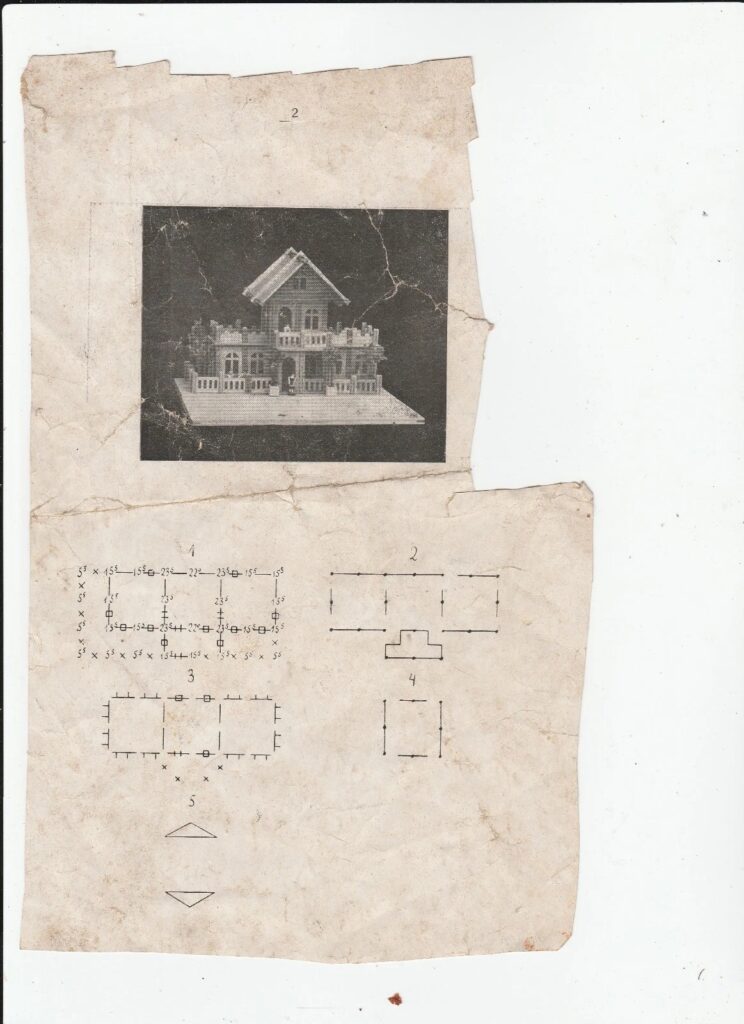
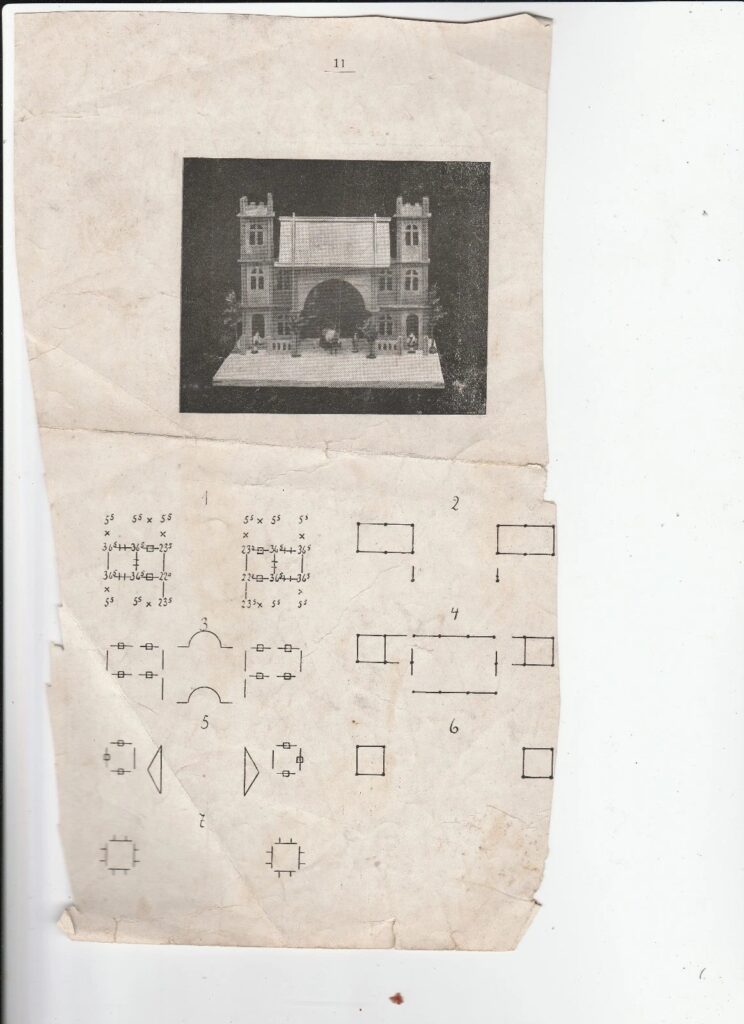
Details manual: Caro items
- The front cover manual 'Set-3 Caro', is different:
- Title: 'Pulko Patent Baukasten' → 'Pulko'.
(Was this before patent application?) - The 'Caro bridge-model' is replaced by: photo of prototype building A.
- The box reference is changed to into smaller font size: "Nr. 3 (Caro)."
- Title: 'Pulko Patent Baukasten' → 'Pulko'.
- Examples building instructions:
- Interestly: the building photos' still showing half round window panels.
(Cannot find any 'rectangular' door panels either.) - There is only one front view of this gable type-II shown (See "pag. 2"):
- This gable design is a little different, then type III above.
(It's missing the straight part on top.) - It's difficult to see the 'window type' on the gable.
(I'm expecting a rounded shape. High resolution scan would be great...)
- This gable design is a little different, then type III above.
- Columns:
- Numbered: 6 lengths in total: 5.5, 15.5, 22, 23.5, 26 & 36.5 [cm].
- Lengths written inside instructions.
(Later instruction using part-numbers, which is also copied by Mobaco.) - Although difficult to see, most likely square columns are photographed.
- New symbols on the drawings:
- Arc: for the bridge.
- Triangle: for the gables.
- Interestly: the building photos' still showing half round window panels.
Details front covers manuals: Addo, Baldo
- Addo front cover is now colored, newer version?
- Baldo front cover is still black/white, like before.
What to conclude?
It's a mixed collection of parts. Assumption about Caro items:
- Caro manual: early manual type (~1919/'20?).
- New parts, like large rectangular windows & doors, new gables & bridge parts:
Prototype Caro-material, fitting the 'round-column' production phase... (so '20 to '23s)
Part development: Pulko Patent Baukasten
A lot of parts are changing, during this short 'Pulko Patent Baukasten' life time:
- Groundplates:
- Type-I: Square through-hole hole (patent).
- Type-II: Round holes, not through hole (Set 1-2).
- Columns:
- Type-I: Square with 2 chamfered sides on top (patent).
- Type-II: Square rounded, no additional tip shape. (Set 1 & 2.)
- Type-III: Round and 4 chamfered sides on top. (Set 1 & 2.)
- Panels:
- Difference in production (1920-'22 period):
- Type-I: Sawing all holes.
- Type-II: Cut holes and glue parts together. (A seam is shown.)
- Different appearances:
- Bauhaus style (patent)
- Rounded window style (Set 1-2)
- Rectangular windows style (Set-3 & prototype buildings (A3)).
- Difference in production (1920-'22 period):
- Floor strips/panels:
- Type-I: Rectangular squares on inside & outside (patent).
- Type-II: Straight, with round holes. (Set 1-3.)
- Gables & roofs:
- Flat: patent & Set 1-2.
- Angled roofs:
- Prototype building A: using gable type-I & roof type-I.
- Caro manual: using gable type-II & roof type-II.
- Caro green parts: using gable type-III & roof type-II.
Parts development: Mobaco
Mobaco parts development:
- Unknown if there was some sort of cooperation with E. Pulkowisky.
- Units used: imperial (instead of metric Pulko-Patent-Baukasten).
- Back to square columns.
- Except for the first year, back to 'through-hole' ground plates, like the patent.
- Panels & groundplates: cardboard, way cheaper to produce.
- 'Invention': interlocking roof panels.
The Pulko prototype building D, could be found back within Mobaco instructions: Set 4, model 61:
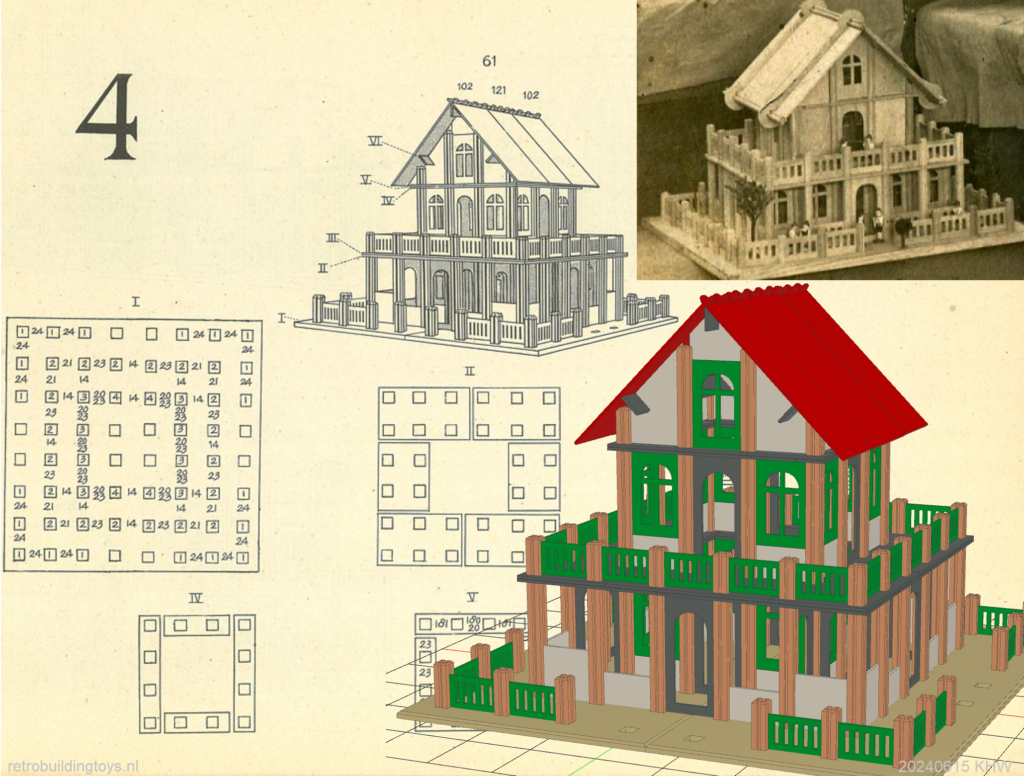
Library information
The next 'part groups' could be identified:
- Parts from the patent. (1919)
- Parts from early prototypes, like buildings A & B. (1919-'20?)
- Parts from "Set-3: Caro (sale)". (Also (1919-'20??)
- Parts during sales: Set-1, 1a & Set-2. (1920-'22)
- Prototype building D: 'Swiss chalet'. (≤1922)
Here you see an overview of library v1.0. Basically all parts sold during 1920-'22 period, incl. intended Set-3 Caro:

(Although for Caro, this library is still missing the 3 story column.)
Part categories:
| Part groups: | Numer of parts: |
|---|---|
| Base plates | 2 |
| Columns | 3 |
| Wall panels | 7 |
| Horizontal floor strips | 8 |
| Horizontal floor panels | 5 |
| Roof panels (flat) | 3 |
| Total parts: | 28 |
Some system characteristics
Here a short list of some system characteristics and how it's retrofitted into the virtual LeoCAD library:
| Part types: | Original: | Virtual: |
|---|---|---|
| Base plates | Wood - spruce wood 15 [mm] thickness | Uncolored pieces |
| Columns | Wood - beech wood Round ~11-12 [mm] | Uncolored pieces |
| All panel elements | Wood - beech wood 3.5-4.0 [mm] thickness | Uncolored pieces |
| Bay size | 60 [mm] | Scaled to match Mobaco: Bay size: 57.5 [mm] |
| Standard wall panel | 52.5 x 10² [mm] | Scaled to match Mobaco. |
Library update (v1.6...)
With newer insights, the library is (again) under construction...
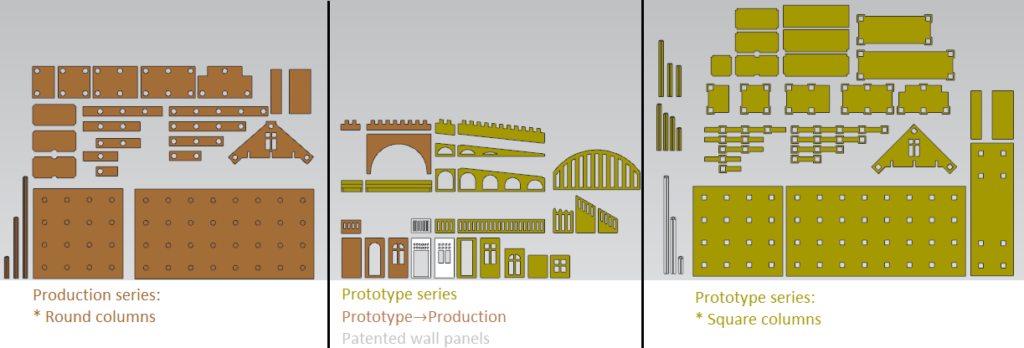
Missing: columns, small gables & roof systems (ao. building D)...
Playing with LeoCad
Early LeoCAD implementation (v1.0) with 'wooden' textures:


cover lid & front page manual
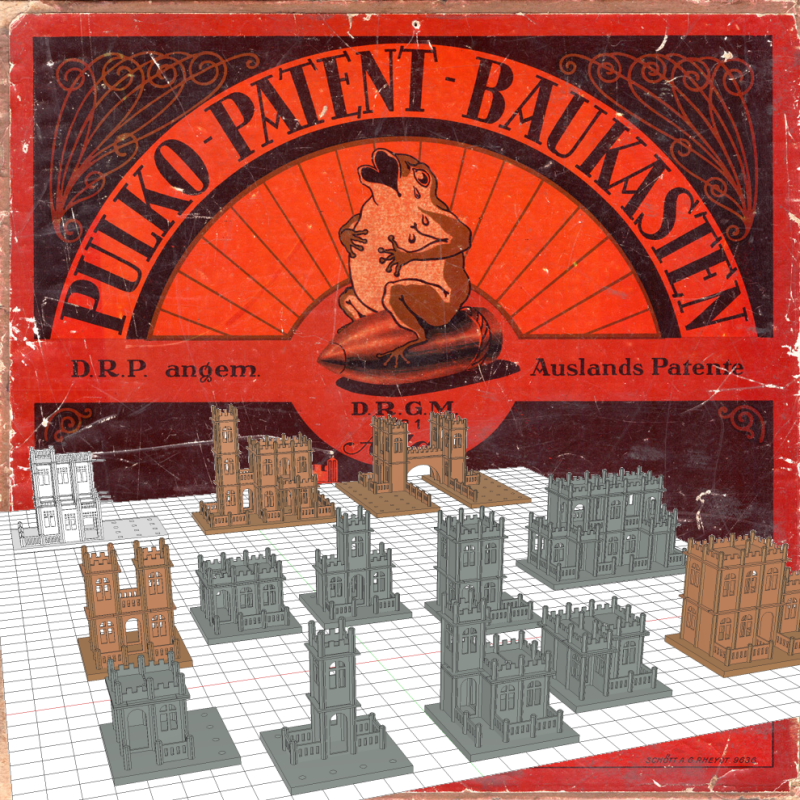
Created some examples from the boxes & covers. There are 2 ways of building floors/roofs:
- Using floor panels (more difficult to remove),
- Using floor strips + roof panels.
(These floor panels could be removed, while playing, so the interior of the building could also be used.)
Downloads
This show the part developments of the 'Pulko Patent Baukasten' building game:
- Click here for many more details: mobaco.nl/pulko.
- See 3D building examples on: SketchFab.com.
- Reproduction: Creating some Pulko parts.
- Read more about today's Tatami.
- The Pulko library is included inside the Mobaco library, available at: Cults3D.

